From Promise to Performance: How to choose the right AI solution for improved physical security?
.avif)

The physical security industry has undergone a seismic shift, and the term “AI” is now everywhere. It’s presented as the definitive solution to every challenge, from overflowing video archives to sophisticated, coordinated threats. For security leaders, navigating this fog of AI promises is daunting. How do you separate genuine innovation from marketing hype? How do you ensure a significant investment today doesn't become expensive “shelfware” tomorrow?
What is AI in Physical Security?
Before getting into the weeds of the frameworks and the value you should expect from AI solutions, let's take a step back and understand what "AI" in physical security means.
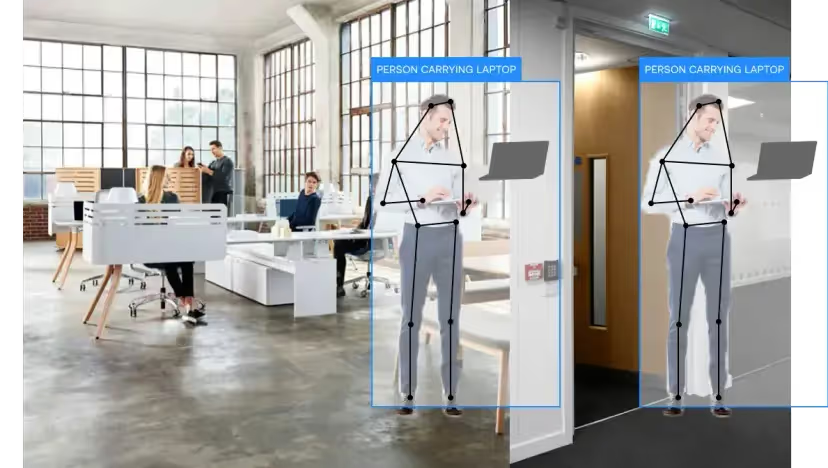
Generative AI that you may be familiar with, think ChatGPT or Claude, are trained mainly on data sources that contain text and other digital media - and despite their strengths, lack the true grasp of the physical world. Purpose-built AI models for physical security are trained on data from the physical world, and this is the engine that transforms security from reactive to proactive. Instead of just detecting a person, a system powered by this AI understands the context and is able to detect a security breach, such as a person loitering in a secure area.
And that is why we need a clear set of principles that define what AI for physical security must do and how it must operate to deliver tangible results. Without this blueprint, even the most advanced technology is likely to fail in the complex, dynamic environments we are tasked with protecting.
This framework is built on two core components: The Three Pillars of Value, which represent the ultimate goals of implementing AI in physical security, and The Five Tenets of AI Security, which are the non-negotiable principles required to achieve them.
The Three Pillars of AI Value In Physical Security
Before we talk about technology, we must define success. What should a true AI for physical security platform deliver? After years of seeing what works and what doesn't, we’ve identified three core outcomes.
- High Efficiency: Your team’s most valuable asset is their attention. But legacy systems swamp them with irrelevant alerts and demand countless hours of manual video review. A true AI platform flips this dynamic on its head. It becomes a force multiplier—filtering out the noise, automating routine tasks, and surfacing only what truly matters. The result? Security personnel are freed from the mundane, allowing them to focus their time and expertise on the critical few, not the noisy many.
- High Operational Precision: Security isn’t about spotting motion—it’s about understanding intent. Without context, an alert is just background noise. A system that flags “a person in a hallway” tells you nothing. But one that flags “an unauthorized individual attempting to enter a server room after hours”? That’s intelligence. This is the difference between seeing and understanding. A truly AI-driven system embeds contextual awareness into every detection—who, what, when, and where—so your team can act with confidence and speed. You get fewer distractions, smarter prioritization, and faster, more effective response.
- Proactive Vigilance: Traditional security reacts. AI-driven security anticipates. The real promise of AI is not just to tell you what happened, but what’s about to happen. By detecting early indicators—like loitering, tailgating, or crowd buildup—a modern AI system enables your team to intervene before an incident unfolds. This shift from forensic review to real-time prevention isn’t just a step change. It’s a new era: one where your team is always one step ahead.

When comparing solutions, use these pillars to assess their relative effectiveness.
The Five Tenets of an AI-driven Platform For Physical Security
Having defined the destination, let’s talk about the foundational principles that a true AI solution must embody to deliver on its promise. When evaluating potential partners, measure them against these standards.
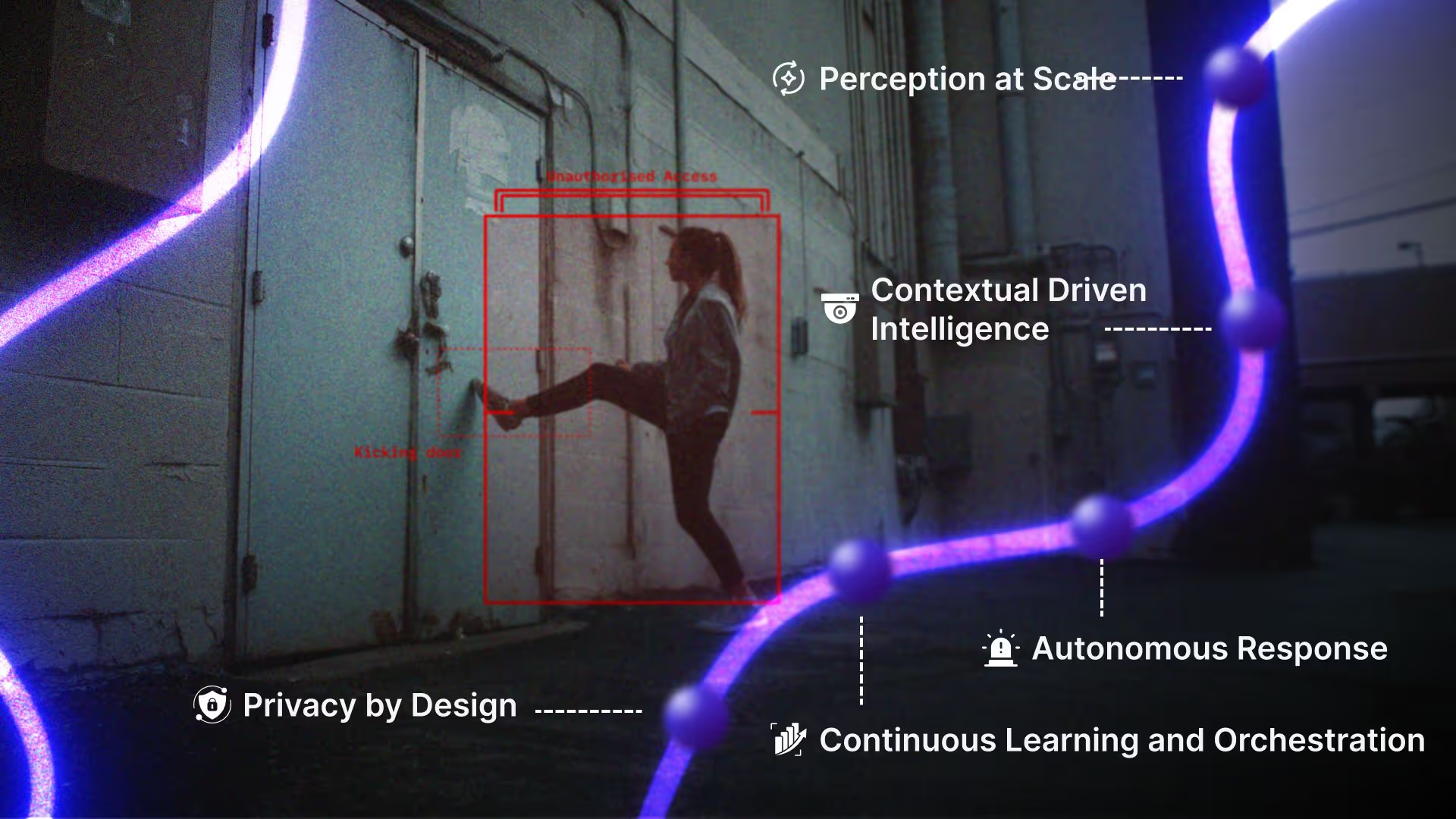
- Perception at Scale: A security operation is only as strong as what its operators can see, yet human attention is a fundamentally limited resource. An AI-driven platform acts with superhuman attention, continuously analyzing every video, sensor, and access control feed to ensure no event is missed and relevant signals are identified with machine-like precision. Security needs are not static; they grow and evolve. An AI solution must perform with the same accuracy and speed whether it's deployed at a single office or across a global network of hundreds of sites. This requires an architecture built for elastic scale, ensuring consistent performance without compromising on reliability as your organization expands.
- Contextual Driven Intelligence: An alert without context is just meaningless noise. Legacy analytics that flag simple motion create a storm of false alarms, desensitizing operators to real danger. An agentic system applies behavioral intelligence and deep scene awareness to move beyond simple detection to genuine comprehension. It understands not just what is happening, but why it matters—distinguishing a real threat, like a person loitering near a fence at 3 AM, from the routine activity that defines your environment.
- Autonomous Response: Real-world threats unfold in seconds, often faster than a human operator can react, and this gap between detection and action is where security fails. A system that simply flags an event for review still places the entire burden of response on your team. True agentic AI closes this gap by initiating actions based on the threat's type and severity—autonomously escalating to an operator, triggering a talkdown deterrent, or logging an incident report without waiting for manual intervention.
- Continuous Learning and Orchestration: A security system that is the same on day one as it is on day 365 is not an intelligent system; it is a static tool. An AI-driven platform gets smarter over time, learning from the outcomes of every resolved incident to improve its accuracy. More importantly, it acts as a central orchestrator, making intelligent decisions that flow across your entire security ecosystem—from your VMS and access control to your alarm and investigation tools—through a common AI platform. Your security infrastructure is a complex ecosystem of cameras, access control systems, sensors, and communication platforms. An AI solution cannot be another isolated silo. It must integrate seamlessly with your existing hardware and software, enriching the data from these systems and transforming them into a unified, intelligent network.
- Privacy by Design: Innovation without trust and scalability is merely a science project, not an enterprise solution. Many point solutions fail when deployed across a large organization, cannot integrate with existing infrastructure, and operate as unaccountable "black boxes". A platform built for the enterprise must be designed to scale seamlessly across all sites and integrate with your existing technology stack. Crucially, it must be built on a foundation of Privacy by Design, with transparent processes and auditable logs to ensure it is a responsible and trustworthy partner in your operations.
From Blueprint to Reality
When you build a house, you start with a blueprint, not just a pile of materials. The physical security market today is filled with AI "ingredients," but it's the agentic blueprint—the deliberate combination of perception, context, autonomous action, continuous learning, and inherent privacy—that separates a collection of features from a truly intelligent solution. By adopting this framework, security leaders can finally move beyond the hype cycle and make strategic decisions based on a clear model for success.
Platforms embodying these agentic principles, like Ambient.ai, are designed to deliver on this promise from day one. They are built not just to see events, but to act as a force multiplier for your team, transforming your existing security infrastructure into a proactive, unified defense network. This is how the long-held goals of the industry are finally met: false alarms are dramatically reduced, investigations are accelerated from days to minutes, and—most importantly—threats are anticipated and prevented before they can escalate.
The choice for security leaders is clear. The future is not about buying more cameras or hiring more guards; it's about investing in a smarter, agentic posture. It is time to move beyond systems that merely watch and embrace a security platform that perceives, understands, and acts.