The ROI of AI in Physical Security
.webp)

10x faster response. Same cameras. Same team.
The ROI of AI in physical security has become a defining concern for enterprise leaders managing expanding camera networks and security operations centers. With the global physical security services market projected to reach $235.1 billion by 2033, organizations need investments that deliver measurable returns rather than incremental improvements. Understanding where AI creates value starts with recognizing why traditional approaches fall short.
Key Takeaways
- AI transforms physical security from a reactive cost center into proactive protection with measurable financial returns
- Contextual intelligence eliminates the false alarm burden that overwhelms traditional monitoring operations
- Behavioral precursor detection enables intervention before incidents escalate, delivering the highest ROI impact
- AI-powered systems break the linear relationship between camera coverage and staffing requirements
ROI of AI in Physical Security Explained
The ROI of AI in physical security refers to the measurable financial and operational returns organizations achieve when deploying artificial intelligence to analyze video feeds, verify access control alerts, and detect threats across camera networks.
AI-powered physical security delivers ROI through four primary value streams: reduced false alarm processing costs, decreased labor requirements for monitoring and investigations, faster incident response that limits damage and liability, and early detection of behavioral precursors that prevents incidents entirely.
Organizations typically see ROI within the first year of deployment, with returns compounding as AI enables coverage expansion without proportional headcount increases.
Why Traditional Physical Security Monitoring Fails to Deliver ROI
Enterprise security teams deploy thousands of cameras across corporate campuses, data centers, and critical infrastructure. Yet just a fraction of all surveillance video is watched live. A single GSOC operator may be tasked with monitoring dozens of camera feeds simultaneously, an impossible cognitive burden regardless of skill or dedication.
The economics compound the problem. Traditional motion-based surveillance generates false alarm rates exceeding 98%. False alarms consume operator time, trigger unnecessary emergency responses, and result in regulatory fines.
Human attention simply cannot scale. Operator performance declines significantly after just 20 minutes of observing a single screen, with operators overlooking up to 90% of activity. Security operations centers experience severe turnover, with more than 40% of security service providers ranking turnover as their top challenge, driven by chronic understaffing, overwhelming alarm volumes, and burnout from constant false alerts.
The result is a reactive posture where incidents are investigated after the fact, if they're caught at all. Labor costs continue rising while security effectiveness plateaus, as operators become overwhelmed by unsustainable alert volumes.
How AI Addresses the Three Core ROI Barriers in Physical Security
AI-powered video intelligence fundamentally changes the ROI equation by addressing the three core operational challenges of traditional monitoring: false alarm noise, human vigilance limitations, and coverage gaps.
AI-Powered Monitoring Eliminates Human Vigilance Limits
Computer vision enables machines to continuously process video, interpreting visual information from video feeds at scale. These systems identify relevant signals from background noise without the attention decay that affects human operators.
Where a GSOC team might actively monitor a limited number of priority cameras, AI can analyze thousands of feeds simultaneously, flagging only verified threats for human review. Human vigilance declines rapidly during continuous monitoring, making AI-powered systems essential for maintaining consistent detection performance across large-scale deployments.
This shifts operator roles from passive surveillance to active decision-making. Rather than spending time triaging endless false positives, security professionals can focus on responding to genuine incidents.
Contextual Intelligence Reduces False Alarm Costs
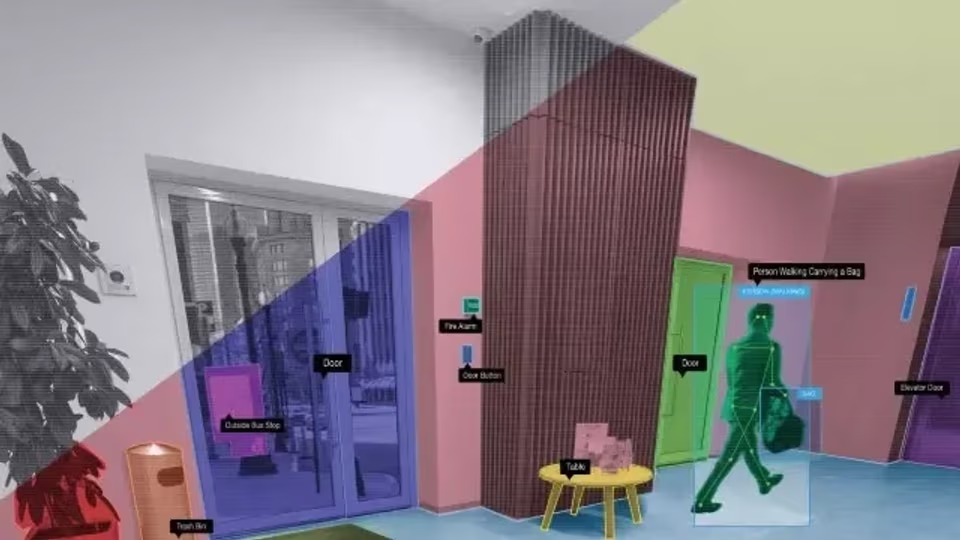
Legacy video analytics rely on motion detection and static rule sets. A person entering a restricted area triggers an alert regardless of context. AI-based threat detection applies contextual intelligence and Vision-Language Models (VLMs) to understand the scene as a whole and assess a detection based on contextual information. This allows the system to distinguish genuine threats from routine activity, such as cleaning staff or authorized personnel. VLMs combine visual perception with language understanding to interpret scenes, behaviors, and intent in ways that rule-based systems cannot.
Intelligent threat detection systems reduce alert fatigue by distinguishing legitimate activities from genuine threats. AI-powered analytics analyzes behavior patterns and environmental context to filter false positives, such as routine maintenance activities or environmental factors like wind-activated motion sensors. By achieving dramatic false alarm reduction, these systems enable security teams to focus on verified threats rather than processing overwhelming alert volumes.
AI Expands Camera Coverage Without Adding Headcount
AI-powered physical security breaks the traditional constraint that more cameras require proportionally more operators. By enabling camera monitoring through AI-assisted analysis, organizations can extend protection to previously unwatched areas while reallocating existing staff to higher-value activities.
Rather than requiring linear staffing increases, AI systems filter irrelevant events and provide verified threat alerts, fundamentally changing how security operations scale.
How to Measure the ROI of AI-Powered Physical Security
Quantifying returns from AI physical security investments requires examining multiple value streams: direct cost reduction, operational efficiency gains, incident prevention, and risk mitigation. Research shows 86% of users see ROI from video analytics within one year.
Where AI Cuts Physical Security Costs First
AI-powered security operations can achieve significant ROI through increased guard and operator productivity, reducing time spent monitoring video feeds, decreased manual operations, and allowing staff to achieve greater coverage. Organizations evaluating these investments should conduct Total Economic Impact analyses that account for baseline operational costs against projected AI-enabled efficiencies.
Guard labor represents the largest physical security expense category. AI-powered remote video monitoring can substantially reduce costs compared to traditional staffing models while maintaining or improving coverage.
How Faster Response Times Reduce Incident Costs
Response time acceleration provides measurable efficiency gains. Security teams using AI-powered threat detection can resolve alerts dramatically faster than traditional manual triage cycles, reducing both incident severity and associated costs.
Investigation acceleration delivers significant returns. AI-powered forensic search capabilities can replace manual frame-by-frame review by allowing operators to query video archives using descriptive search terms. Investigations that previously required hours or days of manual review can be completed in minutes.
Why Detecting Behavioral Precursors Delivers the Highest ROI
Prevented incidents represent the most significant ROI component. The primary value of AI-powered threat detection lies in identifying behavioral precursors to high-severity incidents before situations escalate. Detecting threat signals like loitering near secure entrances, aggressive posturing before fights, crowding that precedes crushes, or restricted area violations provides early warning that enables intervention when threat severity is lowest and response costs are minimal.
By identifying these precursors through contextual awareness, AI systems enable security teams to act during the window when de-escalation is still possible, rather than responding after incidents have fully developed.
How AI Clears Access Control False Alarms at Scale
Physical Access Control Systems generate overwhelming noise that consumes security resources without proportional security value. Door Forced Open and Door Held Open events trigger thousands of alerts annually, with the vast majority representing cleaning crews, delivery personnel, or employees holding doors for colleagues rather than actual security breaches. This is where the false alarm problem is most acute in access control operations.
Access control verification correlates PACS alerts with live camera feeds in real time, automatically clearing false alarms while escalating genuine unauthorized access attempts.
The ROI calculation is straightforward: multiply current hours spent manually reviewing access alerts by average labor cost, then compare against the reduction achieved through automated verification. For large enterprises processing millions of access events annually, AI-powered access control verification can enable substantial annual savings.
How AI Detects Tailgating That Badge Systems Cannot See
Traditional access control systems have zero visibility into tailgating, where unauthorized individuals follow authorized badge holders through controlled access points. Badge-based systems register only the authorized credential, remaining completely blind to additional individuals entering behind. This is not a false alarm problem; it is a detection gap where the threat simply does not exist in the system at all.
AI video analytics provide a net-new detection capability that badge-only systems cannot deliver. By analyzing video at access points, AI can identify when multiple individuals pass through on a single credential swipe. This visibility into tailgating events addresses a security vulnerability that previously went entirely undetected.
How to Build the Business Case for AI Physical Security Investment
Constructing a defensible ROI analysis for AI physical security requires addressing both tangible cost savings and risk reduction value.
What to Include in Total Cost of Ownership Analysis
Comprehensive TCO analysis must include hardware and software acquisition, integration complexity and API development, bandwidth and storage infrastructure, training requirements, maintenance contracts, and monitoring costs for 24/7 SOC operations.
Edge-hybrid architectures have emerged as the operational standard. AI processing occurs on dedicated edge appliances rather than on camera hardware, which affects infrastructure requirements and bandwidth consumption. Multi-year lifecycle analysis is necessary to capture true total costs of ownership.
Which KPIs Justify AI Physical Security Investment
Measurable KPIs that demonstrate AI physical security ROI include:
- Mean Time to Detect (MTTD): Average time from incident occurrence to detection
- Mean Time to Respond (MTTR): Average time from detection to response initiation
- False positive reduction rate: Decrease in non-actionable alerts
- Investigation acceleration: Time reduction for forensic video review
- Coverage expansion: Percentage of cameras under continuous AI monitoring
How Risk-Adjusted Models Quantify Security ROI
Security investments protect against potential losses, not just current expenses. Established risk methodologies calculate expected losses by analyzing avoided losses, recoveries, and total costs of security incidents. AI deployments that reduce incident frequency or severity directly improve security ROI calculations by lowering the expected financial impact of security failures.
The Path Forward for Enterprise Physical Security ROI
The gap between traditional physical security operations and AI-powered capabilities continues widening. Organizations relying solely on human monitoring face unsustainable staffing models, escalating costs, and persistent coverage gaps.
Ambient.ai delivers Agentic Physical Security: AI that autonomously observes, detects, assesses, and responds to real-world threats in real time. By connecting existing cameras, sensors, and access control systems into a unified intelligence layer, Ambient enables security teams to achieve comprehensive coverage without multiplying headcount. Organizations using Ambient shift physical security from a reactive cost center to proactive protection with demonstrable ROI.
Request a demo to see how Ambient delivers measurable returns for your organization.
How long does it typically take for AI-powered physical security systems to deliver a return on investment, and what factors influence the payback timeline?
Payback timelines accelerate for organizations with high false alarm volumes, large camera networks, or elevated incident response costs. Deployment complexity, integration requirements with existing systems, and baseline staffing costs also significantly influence how quickly ROI materializes across different enterprise environments.
What is the difference between traditional motion-based video analytics and AI contextual intelligence for reducing false alarms in security operations?
Traditional motion systems trigger alerts when movement crosses thresholds, generating alarms for any activity. AI contextual intelligence uses Vision-Language Models to interpret object relationships, behaviors, and environmental context, filtering routine activities that occur in normal operational patterns.
How can AI detect tailgating at access control points when traditional badge-based systems cannot, and what makes this a critical security gap?
AI detects tailgating by analyzing video to count individuals passing through entry points and comparing against credential swipes. When multiple people enter on one badge authorization, AI flags the discrepancy, creating visibility where badge readers are blind.