Cloud Video Surveillance Enhanced with AI


95% fewer false alarms. Zero changes to your infrastructure.
How to Make Cloud Video Surveillance More Effective with AI
You've invested in cloud video storage, yet your security team drowns in false alarms while real threats slip through unnoticed. This disconnect between modern infrastructure and outdated analytics creates a dangerous blind spot in enterprise security operations.
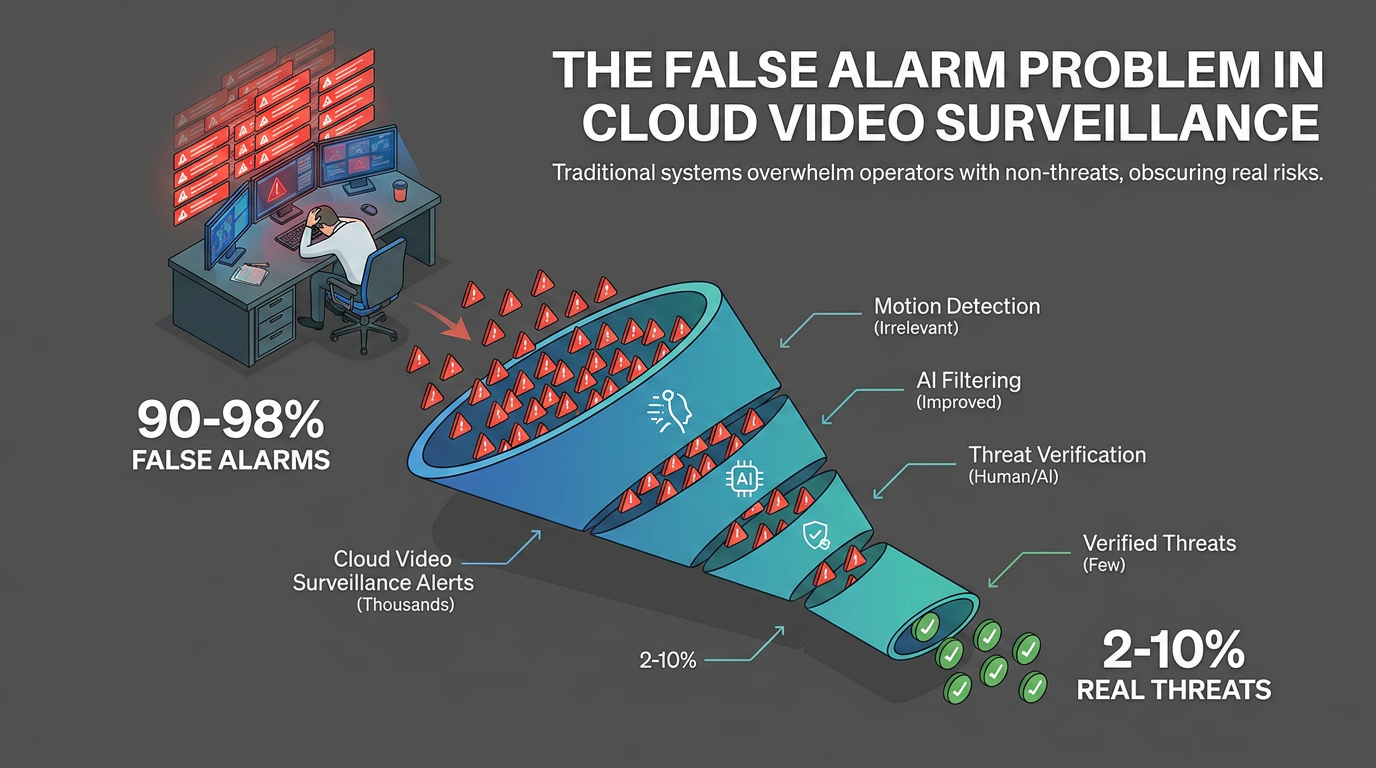
Security teams face an impossible equation: monitor hundreds of cameras continuously while responding to thousands of daily alerts. Studies of typical enterprise deployments suggest that 90% to 98% of these alerts are harmless motion triggers from weather, animals, or routine activities. Operator fatigue peaks exactly when vigilance matters most, and critical incidents get lost in the noise.
AI-powered video surveillance systems change this fundamental dynamic. By adding contextual intelligence to cloud surveillance, organizations filter alert streams from thousands of false positives to actionable events, transforming passive recording systems into active threat-prevention platforms.
The Hidden Cost of Traditional Cloud Surveillance
Traditional cloud video systems excel at storage but fail at intelligent detection. Basic motion sensors trigger on everything that moves, creating alert fatigue that numbs operators to genuine threats. Each phantom alert consumes bandwidth, drains storage capacity, and erodes team focus. GSOC teams spend hours daily clearing motion sensor alerts from access control logs, with most triggered by cleaning staff, delivery personnel, or environmental factors.
AI Video Surveillance Creates Operational Efficiency
Computer vision models fundamentally change security economics by filtering tens of thousands of raw signals down to relevant alerts. When AI handles the initial verification layer, operators can focus on higher-priority alerts and response workflows. This capability matters because most enterprise security teams face hiring constraints and budget pressures that make adding headcount unrealistic.
Labor optimization extends beyond cost reduction. AI eliminates overtime requirements, reduces hiring pressure, and allows security personnel to focus on higher-value activities such as incident coordination, threat assessment, and security policy refinement. Teams shift from reactive alert management to proactive security strategy.
Precision Detection Through Intelligent Recognition
Advanced AI systems verify every motion alert against visual context before escalating to human operators. This multi-layered approach separates genuine security events from the noise that overwhelms traditional systems.
Object classification forms the first filter. AI models identify people, vehicles, and animals while ignoring environmental triggers such as wind-blown debris, shadows, or camera adjustments. Basic object categorization can substantially reduce nuisance alerts in campus security deployments.
Behavioral analysis adds critical context. Instead of simple motion detection, AI recognizes specific patterns that indicate potential threats:
- Loitering near restricted areas versus normal foot traffic
- Tailgating through secured doors versus authorized group entry
- Vehicle wrong-way entry versus standard parking maneuvers
- Person falling (medical emergency) versus sitting down intentionally
- Weapon brandishing versus someone carrying permitted equipment
Temporal and spatial awareness completes the picture. The same activity triggers different responses based on context. A delivery truck at noon passes without alert, while the identical vehicle at 2 AM triggers immediate notification. Large crowds during lunch hours indicate normal operations. The same crowd density rushing exits signals potential evacuation or threat response.
Insights That Drive Smarter Security Decisions
Computer vision models classify every person, vehicle, and behavior in real-time, then assign risk scores based on contextual factors. This categorization enables immediate, informed responses to genuine threats instead of forcing operators to manually verify every motion event.
When someone approaches a restricted door after hours or lingers near critical infrastructure, operators receive alerts within seconds. Each notification includes location data, timestamps, visual evidence, and threat assessment scores. This comprehensive context eliminates guesswork and accelerates decision-making.
Predictive insights emerge from historical patterns. AI identifies when facilities face elevated risk by analyzing time-stamped incident data:
- Weekend security gaps requiring additional coverage
- Quarter-end loading dock congestion needing traffic management
- Seasonal access pattern changes demanding policy adjustments
- Recurring false alarm patterns from specific cameras indicating maintenance needs
These insights integrate directly into security dashboards alongside access control events and incident management systems like ServiceNow. Instead of managing thousands of motion alerts, operators handle only verified, actionable events that require human judgment.
Cloud Architecture Enables Unlimited Scale
AI-enabled cloud surveillance scales without on-premises hardware constraints. Adding new sites or hundreds of cameras requires no additional local servers since processing happens in cloud data centers. This architecture particularly benefits multi-site organizations managing distributed operations from centralized GSOCs.
Centralized management multiplies operational efficiency. Security teams manage dispersed operations through unified interfaces rather than juggling separate systems at each location. Policy changes propagate instantly across entire camera fleets, ensuring consistent threat detection regardless of geography.
Existing infrastructure remains valuable. Compliant cameras integrate directly with cloud platforms, avoiding costly replacement cycles. Hardware-agnostic AI layers work with current VMS platforms like Genetec and Milestone, preserving previous technology investments while adding intelligent capabilities.
Continuous cloud updates keep detection algorithms current across all locations. Every site benefits from the latest threat signatures and behavioral models without manual updates or version management. This consistency ensures that a tailgating detection algorithm in New York uses the same proven model as one in San Francisco.
Real-Time Response When Every Second Counts
Speed determines whether incidents are prevented or merely recorded. AI-driven analytics identify threats within seconds of appearance, delivering verified intelligence directly to security consoles before situations escalate.
Contextual intelligence distinguishes genuine threats from routine activity. Someone repeatedly scouting restricted areas triggers alerts even without visible weapons. Cross-referencing door sensors with visual confirmation eliminates the endless stream of "door held open" notifications from cleaning crews while catching actual tailgating attempts.
Each alert arrives with complete context:
- Live video feed showing the threat
- Event timeline with behavioral progression
- Threat classification and severity scoring
- Suggested response protocols
Operators make informed decisions within seconds, dispatching guards or initiating lockdowns based on verified intelligence rather than raw sensor data. AI prioritizes incidents by severity, ensuring critical threats jump to the front of response queues while low-risk anomalies wait for capacity.
Integration with access control systems like Lenel and HID enables automated responses. Verified intrusions can trigger badge deactivations, door locks, or audible alarms based on predefined threat classifications. Security teams prevent incidents rather than investigate them after the fact.
Fast-Track Your Security Operations
Cloud video surveillance reaches its full potential when AI eliminates the noise that overwhelms security teams. By combining edge-level object classification with behavioral analysis and contextual understanding, Ambient.ai helps reduce unnecessary notifications and accelerate investigations, with the company claiming up to 20x faster investigations.
Ambient.ai leads this evolution with its AI-native VMS platform, identifying over 150 distinct threat signatures through behavioral analysis. The platform delivers proactive threat prevention, cuts false alarms from access control systems, and enables security teams to focus on genuine threats rather than chasing noise.
Evaluate where false alarms drain your team today and discover how behavioral intelligence can transform your security operations. Book a demo to learn more.
Frequently Asked Questions
How does AI-powered video surveillance reduce false alarms compared to traditional motion-based detection systems?
AI-powered surveillance uses computer vision to classify objects and filter environmental noise, then applies behavioral analysis to evaluate intent against location-specific baselines. Temporal awareness adjusts threat scoring based on time-of-day context before escalating alerts.
What specific behavioral patterns can AI video analytics detect to identify security threats before they escalate?
AI video analytics detects precursor behaviors like unauthorized perimeter testing, repeated entry point scanning, unusual congregation, aggressive posturing, fighting, unattended packages, and erratic movement patterns, enabling security teams to intervene before situations escalate into serious incidents.
How does cloud-based AI surveillance integrate with existing camera infrastructure and access control systems like Genetec, Milestone, Lenel, and HID?
Cloud-based AI surveillance connects through standard ONVIF and RTSP protocols, enabling compatibility with most IP cameras. Integration with VMS and access control systems occurs via APIs that pull video feeds and push enriched event metadata back into existing security interfaces.