Computer Vision in Security Systems: What's Possible Now


Investigations that took days. Now answered in seconds.
Computer vision is changing how physical security teams manage a scale problem that skilled operators cannot solve through attention alone: there is more live video and event data than any person can absorb simultaneously, regardless of experience or dedication. The practical opportunity is to give operators timely context while preserving their judgment and command. Understanding where the technology performs well, how it fits existing infrastructure, and how to test it responsibly is the starting point.
What Computer Vision in Security Systems Means
Computer vision in security systems is the use of AI to interpret video and related physical-security signals so teams can detect, assess, and respond to events.
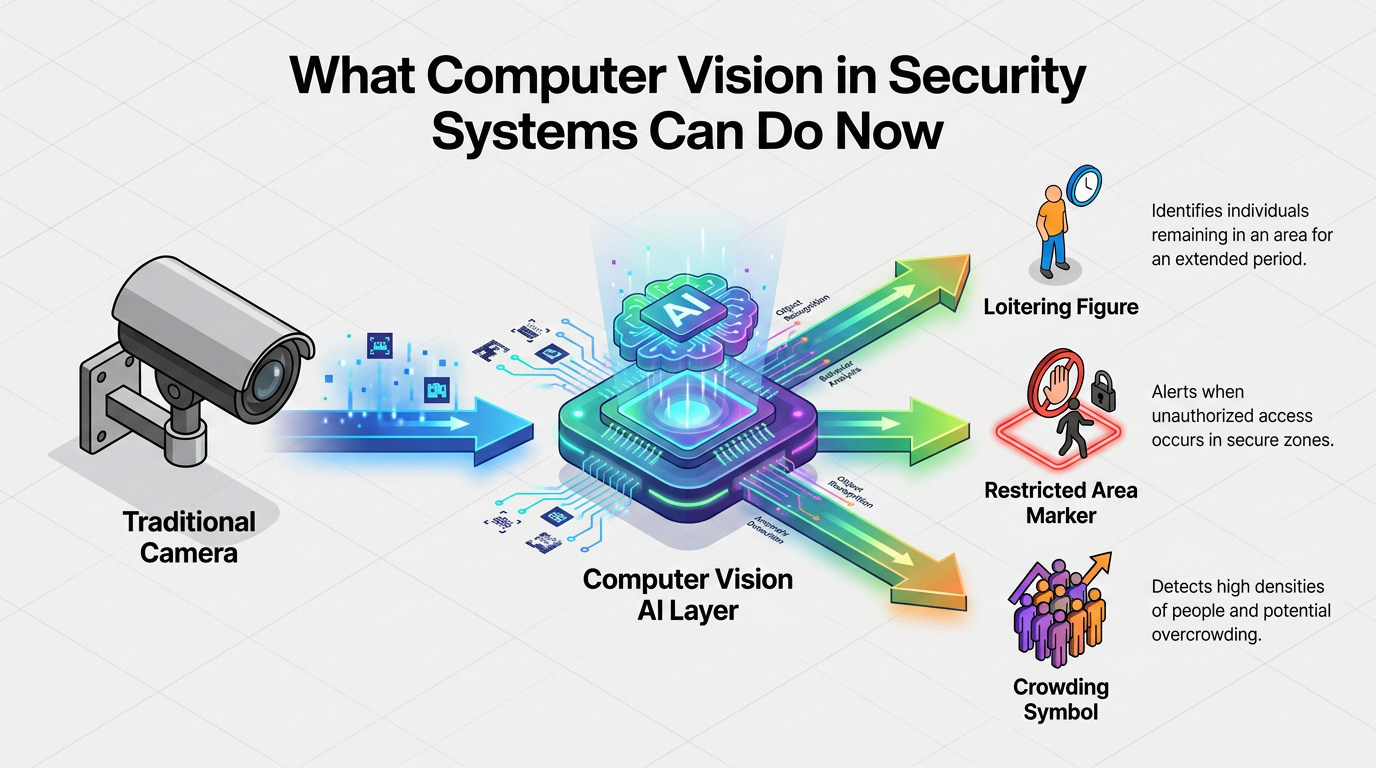
Traditional cameras provide visual evidence, but they do not independently interpret behavior or determine why an event matters. Computer vision adds a separate intelligence layer that can identify people, objects, movement, and activity. Reasoning Vision-Language Models (VLMs) extend that capability by connecting visual observations with language and operational context.
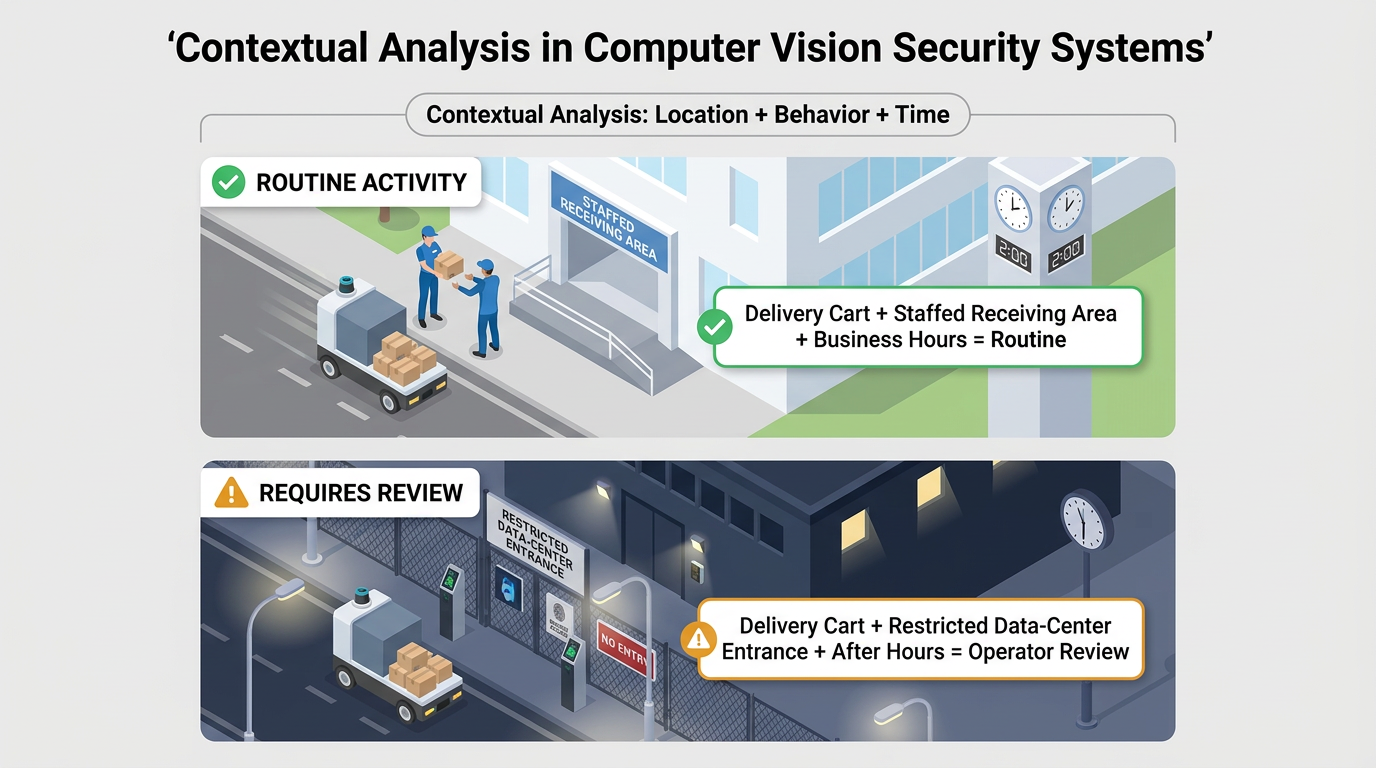
Contextual analysis examines relationships among objects, behavior, location, and time. A delivery cart beside a staffed receiving area may be routine, while the same cart left beside a restricted data-center entrance after hours may require review. This approach helps distinguish ordinary site activity from conditions that warrant operator attention.
What Computer Vision in Security Systems Can Do Now
Modern computer vision can continuously assess video for observable behaviors such as loitering, crowding, fighting, people falling, restricted-area violations, and unauthorized access attempts. These precursors can provide early warning that enables intervention before a situation escalates.
The technology can also connect video with signals from a physical access control system (PACS). A door-held-open event, for example, becomes more useful when the operator receives the associated camera view and can determine whether equipment temporarily blocked the door or someone entered a restricted space.
Alert Validation and Prioritization
Motion rules and door sensors can generate events without enough context to explain what happened. Computer vision can inspect nearby video, classify the visible activity, and route the event according to severity. Low-risk activity can be logged, ambiguous events can be presented for human review, and high-confidence threats can be elevated with supporting video.
This filtering should augment operator judgment rather than remove it. Operators remain responsible for decisions that require policy interpretation, ethical judgment, communication, and field coordination. The technology handles monitoring scale and repetitive validation so staff can focus on consequential events.
Why Alert Quality Matters
The Monitoring Association’s AVS-01 Alarm Validation Scoring Standard materials describe its alarm-validation standard and state that industrywide false alarms range from 90–99%, illustrating why alert volume alone is a poor measure of protection. Repeated low-value alarms can produce a cry-wolf effect: operators still follow procedure, but the queue consumes attention that should be available for credible threats.
Computer vision can improve the workflow by attaching visible evidence, suppressing high-confidence nuisance activity according to policy, and sending uncertain events for review. Security leaders should track the share of alerts that lead to action, not only total detections, and should review suppressed events periodically to confirm that filtering remains safe.
Natural-Language Video Investigation
Continuous stream indexing can make recorded video searchable through ordinary language. Instead of manually reviewing footage camera by camera, an investigator could search for “person in a red jacket near the loading dock during the afternoon,” review matching results, and trace movement across relevant views.
Search results still require validation. Camera angle, lighting, occlusion, and scene complexity can affect what the system retrieves, so preserved footage and operator review remain part of the investigative workflow.
Integrating Computer Vision With Existing Security Infrastructure
An organization does not necessarily need to replace its cameras, video management system (VMS), or PACS to add computer vision. A separate analytics layer can receive video, process it in the cloud, on edge appliances, or through a hybrid architecture, and return event metadata to the security operations center (SOC).
Cloud processing can simplify centralized management but may increase bandwidth use and data-governance requirements. Edge processing can reduce latency and keep more video at the site, although it adds local appliance capacity and maintenance considerations. Hybrid designs divide workloads according to event urgency, retention policy, privacy requirements, and available infrastructure.
Integration Checks
Security leaders should verify the following before deployment:
- Confirm camera-stream compatibility, image quality, frame rate, field of view, and low-light performance at each test location.
- Validate the exact device model and firmware against the ONVIF product database. Membership alone does not establish conformance.
- Map how analytics events enter the VMS, PACS, incident-management tools, mobile devices, and dispatch workflow.
- Define what happens when a camera, network path, edge appliance, or integration becomes unavailable.
- Test event timestamps and camera identifiers so operators receive the correct visual context.
ONVIF Profile M standardizes analytics metadata and event communication, while other ONVIF profiles support video and PACS interoperability. Real-Time Streaming Protocol (RTSP) can provide basic streams when richer integrations are unavailable, but it may not carry the metadata or configuration functions required for a complete workflow.
Designing the Operator Response Workflow
Computer vision creates value only when an alert leads to a clear, repeatable action. Before launch, the SOC manager should document who receives each event, what evidence appears, how quickly it must be reviewed, and which conditions trigger escalation.
A practical response sequence is:
- Detect and classify the visible event.
- Correlate relevant camera, PACS, and sensor context.
- Present the event with a short video clip, location, time, and reason for alerting.
- Have an operator verify the event and select the approved disposition.
- Dispatch guards or notify emergency resources when the response plan requires it, then record actions, resolution, and supporting evidence for review.
Priority should follow the organization’s incident-response plan, with life safety addressed before assets and property. Escalation tiers should distinguish routine policy violations from confirmed threats so operators and field teams understand the required response.
Staffing and Triage Implications
AI-assisted monitoring changes the work queue rather than eliminating the need for trained staff. Leaders should estimate expected alert volume by site and shift, then compare it with operator capacity and response-time commitments. High-severity alerts should interrupt routine work, while lower-priority events can enter managed queues.
Supervisors should monitor false positives, missed events, time to acknowledge, time to verify, dispatch time, and final disposition. Review sessions can identify problematic camera views, recurring nuisance activity, unclear procedures, or alert types that need recalibration. Operator feedback should be treated as an operational input because staff see where context is incomplete or escalation logic does not match site conditions.
Human Attention and Queue Design
Fatigue management belongs in the alert design, not only in staff scheduling. The ASIS International fatigue report treats sustained attention as an operational risk that can affect vigilance and decision consistency. SOC managers can reduce that risk by rotating intensive monitoring duties, protecting breaks, using secondary review for consequential events, and preventing low-priority queues from obscuring urgent alerts.
Computer vision supports this design by watching all connected views continuously and directing people to events that need judgment. Supervisors should still test whether queue rules, staffing levels, and shift patterns produce reliable acknowledgement and verification times.
Procurement and Pilot Criteria
Procurement should begin with the security problem and desired operational outcome, not a feature inventory. The General Services Administration recommends defining mission requirements and testing with a small user group before making a large-scale purchase.
Ask prospective providers:
- Which behaviors and environmental conditions have been validated, and what conditions reduce performance?
- How does the technology connect to the installed cameras, VMS, PACS, and incident workflow?
- Where does video processing occur, and what video or metadata leaves the site?
- How are model changes tested, documented, and communicated?
- What human review remains necessary, and how can operators correct event classifications?
These answers should shape vendor comparisons, pilot scope, acceptance criteria, and the operational safeguards required before a broader deployment.
Enterprise Adoption Context
The ASIS International security trends report found that 57% of security professionals use AI in some capacity. That figure should not be treated as a deployment benchmark for computer vision because surveys may combine active use, limited use, and different security functions.
For procurement teams, the practical question is maturity: whether the technology is operating in a defined workflow, connected to existing systems, governed by policy, and measured against operational outcomes. This distinction helps leaders compare a production capability with a demonstration or isolated pilot.
Pilot Baselines and Acceptance Criteria
Establish the baseline before activating the pilot. Record current alert volume, false-positive rate, operator review time, response time, missed-event rate, and system availability for the selected workflow. Choose representative sites and include difficult conditions such as changing light, weather, crowds, obstructions, and after-hours activity.
Set go or no-go thresholds before reviewing results. Acceptance criteria should cover detection rate, precision, false-positive rate, alert latency, integration reliability, operator usability, and privacy controls. The National Institute of Standards and Technology (NIST) Risk Management Framework calls for testing before deployment and regularly during operation, including documented evaluation of fairness and bias where applicable.
A successful pilot should demonstrate improvement in the target workflow without unacceptable regression in guardrail metrics. It should also identify the staffing, training, network, and maintenance requirements needed to scale beyond the test environment.
Performance Standards and Test Design
International Electrotechnical Commission (IEC) 62676-6 establishes a relevant framework for performance testing and grading of real-time intelligent video content analysis used in security applications. Procurement teams can use the IEC performance-testing standard to structure repeatable test conditions while retaining site-specific acceptance criteria for each behavior and environment.
A test plan should define the event, camera position, lighting, distance, obstructions, expected alert window, and method for recording true positives, false positives, and misses. Repeating the same scenarios after camera changes, model updates, or integration work makes results comparable over time and helps separate model performance from installation problems.
Privacy, Governance, and Ongoing Performance
Video analytics should have a documented purpose, defined retention rules, role-based access, audit logging, and a process for responding to system errors. Security leaders should involve privacy, legal, IT, and workforce stakeholders before deployment, particularly when monitoring employees or publicly accessible areas.
A privacy impact assessment should identify what data is processed, where it is stored, who can retrieve it, and when it is deleted. The SIA privacy code emphasizes Privacy by Design, purpose limitation, data minimization, storage limits, and transparency.
Governance continues after acceptance. Camera movement, focus changes, construction, seasonal lighting, and new patterns of site activity can affect performance. Teams should schedule periodic testing, review operator dispositions, investigate missed events, and maintain a controlled process for changing alert logic or response procedures.
From Computer Vision to Agentic Physical Security
Agentic Physical Security emerges when computer vision continuously assesses events while people retain judgment and command. Ambient.ai delivers this shift by turning existing cameras, sensors, and access systems into a unified intelligence layer that watches every connected feed, surfaces what matters, and preserves operator authority over response.
Built on an always-on, edge-optimized reasoning VLM purpose-built for physical security, the platform compresses investigations from hours to minutes through natural language search and saves 10,000+ operator hours annually across enterprise deployments.
Trusted by Fortune 100 enterprises, it works with existing infrastructure rather than replacing it. Teams evaluating this shift can request a demo.
Frequently Asked Questions
How do you measure the success of a computer vision security pilot beyond just detection rates, and what specific baseline metrics should be established before deployment?
Success measurement should track operator time-to-verify and time-to-dispatch alongside detection precision, comparing pilot results against baseline to confirm workflow compression without bottlenecks. Include system uptime, integration error rates, and operator disposition patterns to ensure operational fit.
How does computer vision integration work with legacy camera systems and existing VMS/PACS infrastructure without requiring a full hardware replacement?
A separate analytics software layer receives standard video streams via ONVIF or RTSP protocols, processes them through cloud or edge appliances, then returns enriched event metadata and classifications back into existing security management interfaces without touching the physical camera deployment.
What are the key differences between cloud, edge, and hybrid processing architectures for security video analytics, and how do you choose the right approach for your organization?
Cloud centralizes compute but introduces latency. Edge processes locally for faster response but requires distributed management. Hybrid architectures split urgent detection to edge while routing forensic workloads to cloud, matching infrastructure to each workflow's speed and privacy needs.