Weapon Detector vs Metal Detector: Key Differences Explained


90%+ alerts resolved in under a minute. See how.
Weapon detector vs metal detector is a comparison between technologies that screen for risk in very different ways. A metal detector responds to metallic objects. A weapon detector is designed to identify indicators of an actual weapon or threat. That difference shapes screening flow, staffing, and coverage. Understanding how they work is the starting point for choosing the right detection approach.
Key Takeaways
- Metal detectors alarm on any conductive object, while weapon detectors are engineered to identify the specific signatures of an actual threat.
- Portal-based screening protects a single chokepoint, while camera-based AI extends visibility across multi-entry facilities and surfaces behavioral warning signs before a weapon is drawn.
- Choosing the right detection approach depends on aligning the technology with entry architecture, staffing reality, and the threats most likely to appear in a given environment.
How Walk-Through Metal Detectors Work
All security metal detectors operate on electromagnetic induction. A time-varying current passes through a wire coil, generating a primary magnetic field. When conductive or magnetically permeable substances pass through, the changing field induces a secondary field in the metal object, which the detector senses. Firearms and belt buckles both trigger this response. The detector cannot tell the difference.
Walk-through metal detectors used for personnel screening are generally described in authoritative sources as operating via electromagnetic induction.
A walk-through metal detector (WTMD) will alarm on a concealed handgun. It will also alarm on a ring of keys, a medical implant, a laptop in a bag, and the steel shank in a pair of work boots. The technology is doing exactly what it was designed to do. The question is whether detecting all metal is the same as detecting threats.
The Sensitivity Calibration Trade-Off
Every WTMD deployment forces a choice between two failure modes. Security officials must balance the size of threats that can be detected against the types of innocuous items expected for a particular application, such as screening commuters versus concert attendees.
Raise sensitivity to catch smaller concealed handguns, and false alarms climb with every phone, belt buckle, and set of car keys that passes through. Lower sensitivity to reduce queue bottlenecks, and smaller firearms may not trigger an alert at all. The trade-off is structural. The detector has no way to distinguish a mass of metal shaped like a pistol from a mass of metal shaped like a laptop charger.
Device Masking in Corporate and Healthcare Environments
The masking problem compounds in device-dense facilities. A heavily ruggedized notebook may contain enough metallic content to trigger an alert or mask a smaller metallic object behind it. The same principle applies to tablets, medical devices, wireless earbuds in metal cases, and the multiple electronic devices a typical corporate employee carries daily.
In hospitals, where staff carry radios, pagers, and diagnostic equipment, and in corporate offices where visitors arrive with laptops and multiple phones, the ratio of innocuous metal to threatening metal is extremely high. Every alarm triggered by a harmless device costs staff time and makes it harder to distinguish urgent events from routine ones. Repeated false alerts can desensitize operators, causing alarms to be treated as routine nuisance signals rather than credible threats.
How AI Weapon Detection Technology Works
AI weapon detection operates through fundamentally different mechanisms than electromagnetic screening. Three primary technology categories exist.
Portal Systems and Automatic Threat Recognition
Active millimeter wave (MMW) systems transmit energy at millimeter wavelengths and measure reflections returning from the body surface and any concealed objects. An automatic threat recognition (ATR) algorithm processes these reflection signatures to identify spatial anomalies consistent with concealed weapons. For privacy, the operator display presents a generic body outline rather than the individual's actual anatomy.
Passive MMW systems sense thermal radiation naturally emitted by the human body. Concealed items block this radiation and exhibit different thermal characteristics compared to the surrounding body surface. University of Glasgow research documents one implementation that applies AI to passive walk-through scanning, detecting metal objects by the shadow they cast against natural terahertz emission. That same research documents reported incidents of undetected knives brought through AI-enabled scanning gates, raising questions about reliability for edged weapon threats.
AI Video Analytics for Visual Weapon Detection
Camera-based systems use deep learning models trained on video to recognize visible firearms, knives, and other weapons in real time. These systems analyze video frames continuously, processing visual data from existing camera infrastructure without requiring people to stop, line up, or pass through a portal.
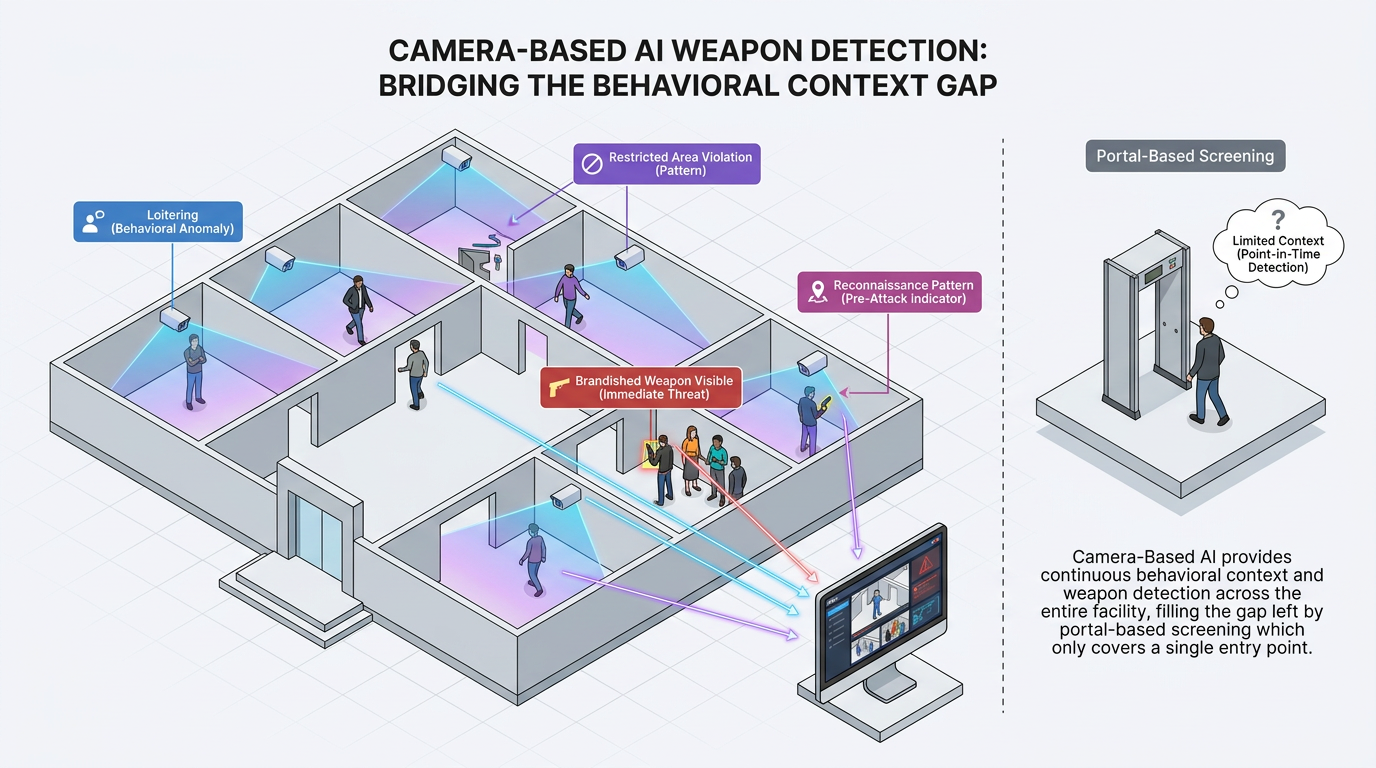
A fundamental physical limitation applies: camera-based AI cannot detect concealed weapons because a firearm hidden under a jacket or inside a bag produces no visual signature for a camera to analyze. Portal-based systems detect concealed threats at a single chokepoint. Camera-based systems detect visible and brandished threats across an entire facility. They address different parts of the threat timeline.
Radar and Electromagnetic Sensor Fusion Systems
A third category combines radar-frequency sensing with optical imaging and AI classification. These systems are designed as walk-through portals that do not require individuals to empty pockets or remove personal items before screening. The DHS market survey compiles vendor-submitted specifications for several systems in this category, but the comparison relies on vendor submissions, not DHS-conducted independent testing. Buyers should require third-party validation from conditions comparable to their own operational environment.
The Standards Gap Between Metal Detectors and Weapon Detectors
The single most significant difference between traditional metal detectors and AI-based weapon detection systems is not throughput, accuracy, or cost. It is whether an independent standard exists to verify vendor claims.
Walk-through metal detectors are governed by ASTM F3566, the current active performance standard. Compliant WTMDs must meet defined performance thresholds for firearm and knife detection, throughput, and false alarm rates, independently tested against a published standard rather than self-reported by the manufacturer.
No equivalent independent U.S. standard currently exists for AI-based passive weapon detection systems. AI portal systems and camera-based weapon detection operate in a standards vacuum. When a WTMD manufacturer claims a specific detection probability, current standards do not provide a definitive framework to verify or disprove that claim. When an AI weapon detection vendor claims comparable or superior accuracy, no independent framework exists to validate the number.
The FTC enforcement action against an AI weapon detection vendor underscored this risk. The FTC alleged deceptive claims, including that the system would detect all weapons, ignore harmless personal items without requiring their removal, detect weapons more accurately and faster than metal detectors, and cut labor costs. Each of those claims existed in a space where no independent standard could confirm or refute them before purchase. Procurement teams evaluating AI weapon detection should require third-party testing results from conditions comparable to their specific deployment environment.
Throughput, Accuracy, and What the Numbers Mean
Every competitor in this space discusses throughput as a primary advantage. A traditional WTMD processes people at a controlled one-at-a-time pace under standard checkpoint protocol. AI portal systems often report substantially higher throughput figures in vendor materials and DHS-compiled comparisons.
The missing context: throughput figures are tied to specific detection probability thresholds, not absolute processing speed. A system configured for high throughput at lower sensitivity may miss smaller concealed handguns. A system configured for maximum sensitivity will catch smaller threats but also flag a dramatically higher volume of harmless items. When evaluating throughput claims, ask at what sensitivity level the throughput was measured and what weapon sizes were reliably detected at that setting.
Zero Behavioral Context Means Missing Pre-Incident Warning Signs
Standard walk-through metal detectors generally cannot detect or distinguish fully non-metallic items such as ceramic knives or some 3D-printed weapons, and they may also miss explosives that lack significant metal components. A single undetected non-metallic weapon can compromise an electromagnetic screening program. Metal detectors only trigger when someone walks through with metal objects, providing no insight into suspicious behaviors that precede incidents.
Traditional WTMDs do not provide behavioral context on their own, but modern AI-based weapon-detection systems can add behavioral context and pre-incident behavior analysis at checkpoints. A person pacing near an entrance, returning to observe guard rotation patterns, or carrying an object consistent with a weapon component generates no signal in any portal-based screening system. These observable precursors, including loitering, restricted area violations, fighting, and reconnaissance behavior, occur in the minutes and hours before a weapon is drawn.
Camera-based AI fills this gap. Models trained on video analyze behavioral patterns across an entire facility simultaneously, identifying precursor indicators that checkpoint screening physically cannot observe. An individual loitering near a perimeter fence late at night, a person running through a lobby while others walk normally, someone accessing a restricted area without authorization: each generates an alert with visual context before a weapon is visible.
The Multi-Entry Campus Problem
Checkpoint-based screening requires funneling every person through a single controlled entry point. For a courthouse with one public entrance, that architecture works. For a multi-building corporate campus, a data center complex with vehicle and pedestrian entries across a wide perimeter, or a hospital system with emergency, staff, visitor, and delivery entrances, single-chokepoint screening creates a structural coverage gap.
Staffing every entrance with portal-based detection is operationally prohibitive. A documented staffing model for WTMDs at a single entrance requires multiple personnel: one directing people on items to remove, bag checkers, wand operators, and an armed security officer. Multiply that across many entrances and the staffing requirement exceeds what most enterprise security budgets can sustain.
Camera-based AI detection addresses this gap by operating continuously across all entry points and interior spaces simultaneously without requiring additional staff per entrance. A security team monitoring a multi-building campus receives alerts from any camera on the network when a visual threat signature is detected, with the specific location, camera feed, and pre-event footage included in the alert package.
Staffing Cost and the Operational Reality of Weapon Detection
Hardware acquisition cost is the number that appears in procurement proposals. Operational staffing cost is the number that determines whether the system actually works.
Traditional WTMDs usually have a lower upfront hardware cost. AI portal systems often use subscription or lease pricing that results in a much higher total contract cost over time. AI portal systems can reduce per-entrance staffing requirements.
The FTC enforcement action specifically characterized one AI vendor's claim to cut labor costs compared to metal detectors as an alleged misrepresentation. Procurement teams should treat all AI weapon detection vendor labor cost savings claims as unverified until independently substantiated by a pilot in their own environment.
A Campus Safety Magazine survey found many participants reported frequently or constantly lacking sufficient personnel to run screening equipment effectively. A deployed system without adequate staff to operate it provides the appearance of security without the substance. Camera-based AI detection can reduce per-entrance staffing needs: existing cameras connected to a detection platform can generate alerts to a centralized SOC across multiple entrances or open areas, though human operators still typically verify alerts and coordinate response.
Privacy and Regulatory Considerations
Corporate campus weapons screening is a voluntary risk management decision, not a federal mandate. ASIS-related guidance indicates that there is no general U.S. federal law regulating weapons in private workplaces, though certain federal rules apply in specific settings such as federal facilities. Any screening program is subject to applicable employment, labor, and anti-discrimination law. Physical checkpoint accessibility is generally governed by the U.S. Access Board's ADA Accessibility Standards, including requirements for accessible routes, clear widths, maneuvering space, doors, and ramps that would apply to screening areas used by wheelchair users and people with mobility devices.
For AI-based systems specifically, a structural legal distinction exists between systems that collect biometric data and those that perform weapon-only visual detection without identifying individuals. DHS and CISA provide critical infrastructure security and resilience resources relevant to physical security planning.
How Camera-Based AI Analyzes Visual Patterns
Camera-based AI weapon detection processes live video feeds through deep learning models trained to recognize visible firearms, edged weapons, and other threat objects. Each verified alert includes actionable metadata like weapon type, camera location, timestamp, and movement direction. Integration with PACS can support unified incident logging within existing security workflows.
A practical scenario: an individual walks toward a loading dock entrance carrying a visible firearm. A camera-based AI system processing feeds from that entrance identifies the weapon, classifies it by type, and generates an alert with video, location coordinates, and a timestamp within seconds. The SOC operator receiving that alert sees exactly what triggered it, where the individual is, and which direction they are moving. That specificity can reduce the need for a building-wide lockdown and search response that an unlocated threat would require.
Installation conditions materially affect camera-based detection performance. Camera mounting height, field of view geometry, and lighting conditions all influence model accuracy.
Matching Detection Methods to Your Threat Environment
Small courthouses or single-entry schools benefit from electromagnetic screening at chokepoints, where metal detectors reveal concealed weapons that might not be visibly brandished. Multi-entry corporate campuses, stadiums, and transit hubs need camera-based AI that monitors many doors simultaneously, identifying brandished firearms and alerting responders before suspects reach lobbies.
DHS discusses the core use-case decision in terms of high-throughput screening and screening scenarios involving divestment and controlled access. Screening procedures can affect alarm rates, throughput, and alarm-resolution workflows. Every sensitivity calibration and staffing model must account for which context applies.
ASIS International frames integration with existing security architecture as a primary evaluation criterion rather than an afterthought. No weapon detection technology operates effectively in isolation. Portal screening, camera-based monitoring, PACS, and incident response plans work as layers. A layered approach positions detection across the threat timeline: before entry, during occupancy, and after an incident begins.
Building Layered Security That Scales
Choosing between a weapon detector and a metal detector is really about choosing where and how detection should happen. Ambient.ai brings that broader model into Agentic Physical Security by using AI threat detection with existing cameras and PACS to give security teams earlier visibility into visible threats and behavioral warning signs across more of the facility. Teams exploring that approach can request a demo.
Related reading:
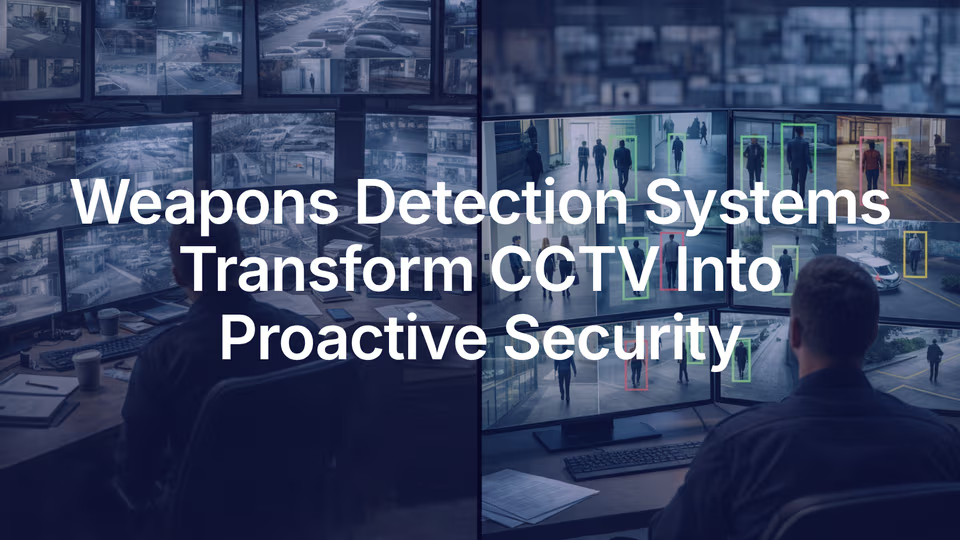
- Weapons Detection Systems: Beyond Traditional CCTV to Proactive AI Security
- Are There Security Cameras That Can Detect Weapons? How AI Tech Works
Frequently Asked Questions
What are the main limitations of AI weapon detection systems compared to traditional metal detectors for detecting concealed weapons?
Camera-based AI cannot directly detect fully concealed weapons because hidden objects lack a direct visual signature, though some systems may infer risk from indirect visible cues such as clothing distortion, posture, or behavior. Portal AI systems lack independent testing standards to verify vendor claims, unlike metal detectors governed by ASTM F3566. Detection accuracy varies with camera angles and lighting.
How do you determine the right sensitivity calibration for a walk-through metal detector to balance false alarms with threat detection?
Sensitivity calibration requires testing with innocuous items typical users carry and validating detection against the smallest credible weapon profile. Pilot testing under operational conditions reveals where alarm volumes become unsustainable while ensuring critical threats remain detectable.
What independent standards or third-party testing should procurement teams require when evaluating AI-based weapon detection vendors?
Procurement teams should require third-party testing in deployment-matched conditions including camera angles, lighting, crowd density, and concealment methods. Results must specify detection probability thresholds, weapon sizes, and false alarm rates at operational sensitivity rather than vendor claims.