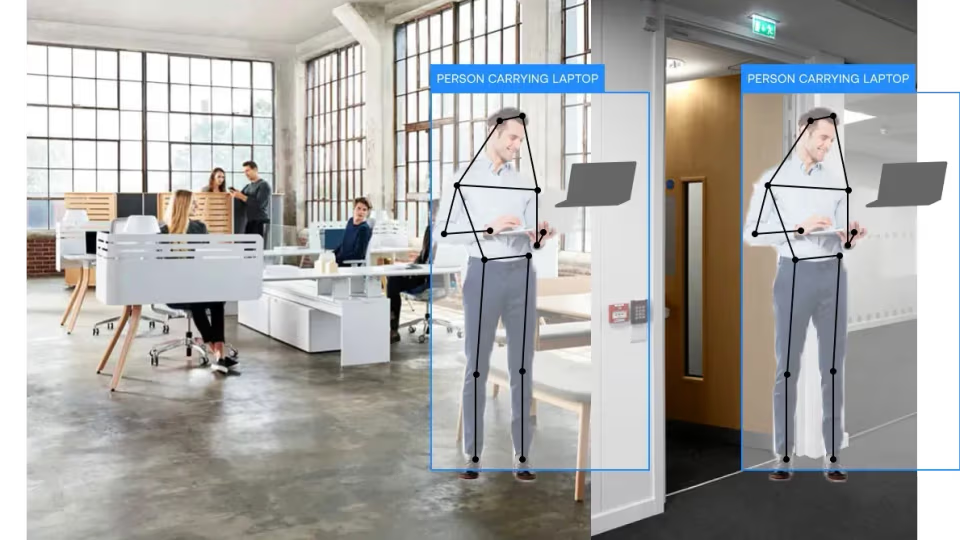
8 Ways to Strengthen School Safety with AI Gun Detection


90%+ alerts resolved in under a minute. See how.
Faster, more accurate gun detection technology gives responders extra time to act and keeps security personnel focused on real risks.
False alarms drain security teams, pulling focus from genuine threats. AI-powered gun detection helps by filtering out noise and reducing false alarms while flagging real risks in seconds.
That's why more and more school districts are turning to AI-powered gun detection layered on their existing camera systems to improve campus safety without costly upgrades.
This guide outlines eight proven approaches to activate or upgrade intelligent gun detection without replacing your current camera network. So that you can reduce false alerts, cut down on response time, and increase protection for students and staff.
Key Takeaways
- AI gun detection layers onto existing school cameras to flag visible firearms in seconds without a hardware overhaul
- Context-aware verification separates real threats from lookalike objects and cuts the false alarms that erode staff trust
- Zone rules and automated lockdown workflows turn detections into coordinated action across staff, SROs, and responding officers
- Privacy policy, layered defenses, and district-wide standards determine whether the technology delivers durable school safety outcomes
What AI Gun Detection Means for Schools
AI gun detection is a computer vision capability that analyzes live video feeds from existing school cameras to identify visible firearms and alert security personnel within seconds. For schools, it means faster threat awareness without replacing camera infrastructure.
Unlike static rules, modern systems interpret behavior and scene context, distinguishing a brandished weapon from a lookalike object and routing verified alerts to staff, school resource officers, and law enforcement before an incident escalates.
8 Proven Approaches to AI Gun Detection in Schools
The following eight approaches show how districts can activate, refine, and scale AI gun detection on the camera network they already own. Each one addresses a specific operational gap, from initial deployment through law enforcement handoff, and together they form a practical playbook for turning existing cameras into an early-warning layer.
1. Layer AI Gun Detection onto Your Existing Cameras
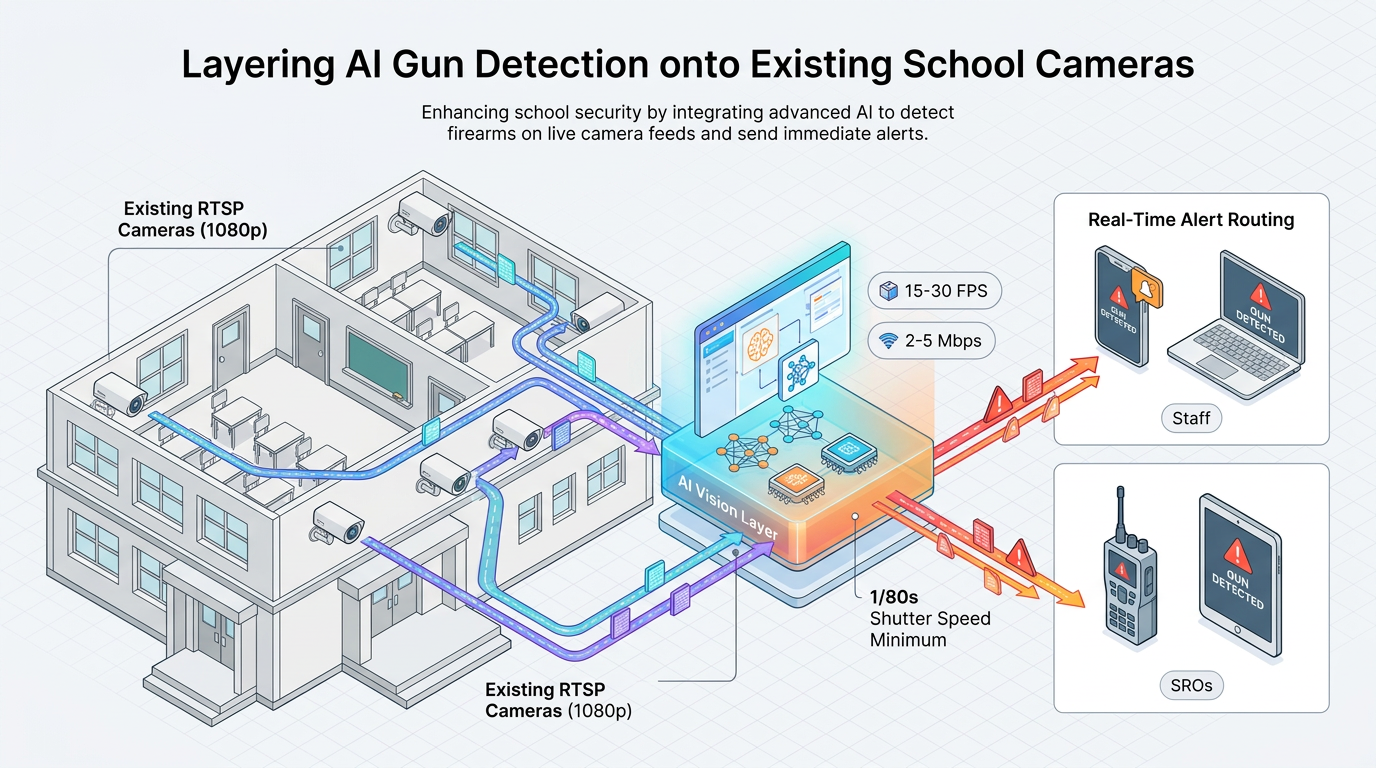
Most public schools already have security cameras. But most of these cameras can't tell the difference between a weapon and an everyday object like a backpack. Adding an AI vision layer fixes that. The software analyzes video feeds in real time and sends real-time alerts to your security personnel if a firearm is detected.
You can enable this software with existing RTSP-enabled cameras from vendors like Axis, Hanwha, Bosch, and Avigilon. In other words, you may not need to invest in new hardware to improve weapon detection.
Physical security AI platforms are hardware-agnostic, so a district can activate detection on hundreds of cameras and reach campus-wide coverage in days rather than months. Access control integrations across Genetec, Lenel S2, Brivo, and Honeywell let the same alert reach doors and dispatch procedures without a second console.
Take note, though, that some older cameras may need upgrades, and small adjustments to lighting can increase visibility.
In most cases, a standard HD stream is enough. Cameras running at 1080p resolution (full HD) provide the accuracy AI systems need to distinguish, for example, a black Chromebook from a black handgun. Each stream uses about two to five Mbps at 15 to 30 frames per second, so most existing networks can handle the load.
For optimal weapon detection, configure cameras with shutter speeds of 1/80th minimum or 1/250th for best performance. Some older cameras may need upgrades, and small adjustments to lighting can increase visibility and reduce false positives.
Educational Safety Technology AI Gun Software Requirements
Before comparing vendors, audit the fleet you already own against the prerequisites the Partner Alliance for Safer Schools publishes in its Safety and Security Guidelines:
- Resolution and distance. Each camera sits close enough for a handgun to register as more than a few pixels.
- Lighting and sightlines. Illumination stays consistent and shelving, banners, and seasonal decorations don't block the view.
- Testing in place. Validate at the actual deployment location, not in a demonstration staged in a controlled room.
- Stream access. Confirm the camera models on campus expose streams to third-party analytics, since some manufacturers restrict outside integration entirely.
Run that audit before vendor selection. The gaps it surfaces drive the budget more than the license does.
2. Use Context-Aware Threat Verification to Eliminate False Alarms
One of the biggest challenges with gun detection systems in public schools is the flood of false alarms. Security teams burn through valuable time chasing alerts that turn out to be harmless props long before a real threat appears.
Context-aware threat verification fixes this by asking a deeper question than just "Is this a gun?" It asks:
- Is the weapon brandished?
- How is the person moving?
- Where on campus is this happening?
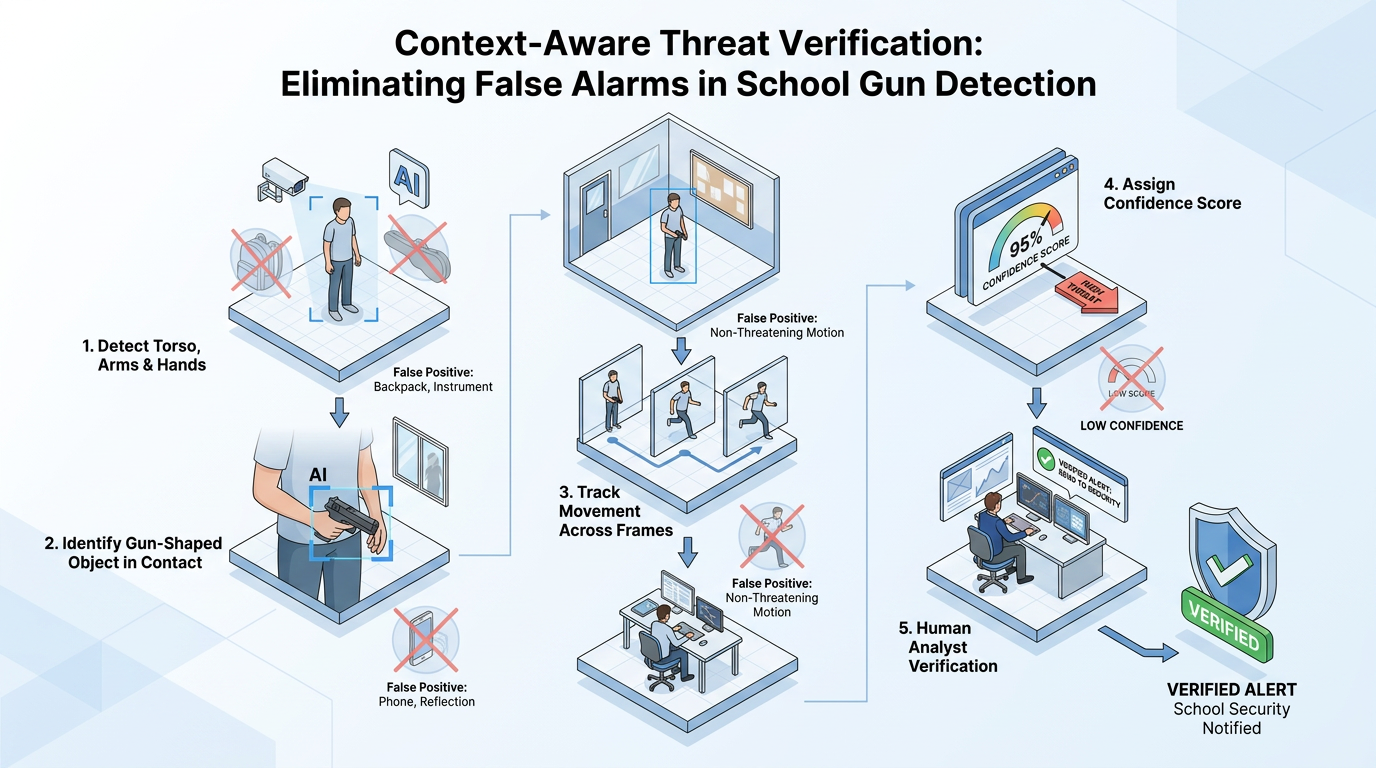
Modern AI-driven systems like Ambient.ai approach gun detection in layers.
Ambient.ai, specifically, leverages reasoning models capable of understanding the context, not just elements of a scene. This allows to enhance accuracy of detection by interpreting behavior. For example, by detecting a person's torso, arms, and hands first, the platform checks for a gun-shaped object in contact with that individual. Next, it tracks both the person's body and the object across multiple frames, looking for telltale movements such as a draw or purposeful pointing. Movement of other individuals running away or going to the ground could further confirm an emerging threat.
Only after this step-by-step review does the system assign a confidence score and decide whether to alert. This multi-stage approach dramatically reduces fleeting "phantom" detections caused by reflections, backpacks, or unusual camera angles.
High-confidence alerts route to trained security analysts who verify the threat within seconds before triggering lockdown procedures, combining AI speed with human judgment to eliminate false positives.
To implement context-aware verification effectively, configure your system to cross-reference weapon detections with badge access logs from your existing access control system. Then, establish a verification protocol where high-confidence alerts trigger immediate lockdown procedures, while medium-confidence alerts route to your security operations center for human review within 30 seconds.
Advanced physical security platforms work with security teams to integrate access-control data and update detection models with fresh campus footage to adapt to new uniforms, backpacks, or seasonal lighting changes. This manual calibration by trained analysts ensures detection accuracy remains high as campus environments evolve throughout the school year.
Other capabilities of context-aware verification include:
- Checking access logs and occupancy data to confirm whether someone or something should be in a space (e.g., a weapon in a locked lab after hours versus a weapon during Reserve Officers' Training Corps (ROTC) practice).
- Adjusting sensitivity by zone, with stricter rules for high-risk areas like entrances and hallways, and looser thresholds in low-risk areas.
- Training on campus-specific data to filter out common false positives like band instruments, umbrellas, or tripods.
- Adding a human-in-the-loop review, where trained analysts verify suspect frames in real time before lockdowns are triggered.
With these safeguards in place, students and staff stay safer, and security staff can focus on real threats instead of wasting time clearing harmless alerts.
Note: Schools can complement gun detection with occupancy sensors and metal detection technology for comprehensive threat prevention. However, reactive technologies like acoustic gunshot detection systems should be considered secondary measures since they only activate after shots are fired rather than preventing incidents before they escalate.
What Security in Schools AI Gun Detection Cannot See
Context reduces false alarms. It does not extend the field of view. The Partner Alliance for Safer Schools states the constraint directly: a weapon concealed under clothing or inside a bag will not be detected by video analytics. A firearm outside a camera's coverage, screened by a crowd, or too distant to resolve produces the same result. At Antioch High School in Nashville, an AI weapon detection deployment did not identify the handgun used in a shooting, and district officials attributed the miss to the shooter's distance from the cameras.
Ask which corridors, stairwells, and parking areas have no usable view today, and what it costs to close each gap. The Monitoring Association's alarm validation standard supplies contract language for the rest, defining tiered alarm levels from no call for service through a confirmed threat to life. Use it to pin down which tier a brandished-firearm detection receives and whether an unresolved alert defaults to notifying or holding.
3. Set Zone Rules to Focus on High-Risk Areas
Zone rules let schools decide how the weapons detection system should respond in different parts of campus.
This level of control is important because different parts of a school carry different levels of risk.
For example, entrances and administrative offices are high-risk areas because that's where outsiders first appear and staff are concentrated. A football field or cafeteria, by contrast, naturally has more movement and noise, which makes strict sensitivity settings impractical.
By assigning rules to each zone, schools can make sure the system reacts quickly in critical areas while avoiding unnecessary alerts in low-risk spaces.
Start by creating a digital map of your campus in your security dashboard. Mark high-security zones like entrances and administrative offices with the strictest rules and immediate response. Spaces such as cafeterias and gyms can allow for more activity, but still need fast checks. Classrooms and hallways fall in the middle, while outdoor areas can tolerate more variability.
To keep this system effective, run walk-throughs, update thresholds, and adjust for changes in lighting or construction. Some AI solutions, like Ambient.ai, also use continuous learning to reduce false alarms and keep critical zones, such as entry points, highly sensitive at all times.
Zone Rules That Catch Behavior Before a Weapon Appears
The same map that tunes firearm sensitivity also defines what counts as unusual activity in each space. That matters because the U.S. Secret Service's National Threat Assessment Center studied averted plots and found that plotters commonly signaled their intentions in advance, often well before a weapon appeared.
Configure zones to surface precursors alongside firearm detections: after-hours presence near restricted areas, perimeter probing and fence climbing, propped doors and tailgating at controlled entries, crowd formation or fights, and a sudden rush of people away from a doorway. These signals give staff early warning that enables intervention before situations escalate. They do not replace a reporting program or a multidisciplinary threat assessment team.
4. Automate Lockdown and Emergency Workflows
When a weapon appears on camera, you have seconds to act. Automated lockdown and emergency workflows help schools act quickly by turning detections into clear, repeatable steps.
Here's an example of an automated emergency workflow:
First, the system verifies the alert. Platforms like Ambient.ai route flagged images to trained analysts, who confirm threats within seconds.
Once verified, the system can trigger automated actions such as locking exterior doors, sending alerts, or activating alarms. Ambient.ai customers resolve over 80% of alerts in under one minute.
A strong playbook usually covers:
- Verification: Confirming high-confidence detections before escalation.
- Alert routing: Sending the right type of message to administrators, SROs, and district security.
- Lockdown commands: Integrating with access-control systems to secure doors and restrict movement.
- Emergency notifications: Triggering PA systems, lights, and mobile alerts.
- Law enforcement access: Providing secure links to live video and maps.
Sequence matters as much as the list. Decide in advance whether the first notification lands with a school resource officer, a district security operations center, or the front office, and what each recipient can do without waiting for confirmation. An undefined first recipient turns a two-second detection into a two-minute phone tree.
Automation supports speed, but people still make the final call. Regular drills ensure the process works smoothly and reveal gaps that technology alone cannot cover. Over time, this combination of automation and practice reduces response times from minutes to seconds.
5. Train Staff With Realistic Alerts and Drills
Train your people from day one so that they know how to work with your AI gun detection systems to make your school as safe as possible. These training sessions should cover system alerts, lockdown triggers, and mobile notifications.
You should also have quarterly refreshers with real-world case studies. And encourage new hires to shadow their first drill after a quick onboarding session.
Most vendors support safe practice modes. For example, Ambient.ai offers simulation features that send test alerts through the live interface, letting staff rehearse recognition and escalation steps without involving emergency services.
Combine scheduled walk-throughs with surprise tests, and measure two things each time:
- Time to verify (staff confirm detection)
- Time to act (doors locked, announcements made)
Add a third check most districts skip. Confirm during a tabletop exercise that a responding officer can pull the correct camera on a phone and that the feed is genuinely live.
The Cybersecurity and Infrastructure Security Agency's active shooter planning guidance treats timely intelligence as critical and expects surveillance accessible to mobile devices to reach responding units early.
Adjust sensitivity after each drill to reduce false alarms. Regular practice builds confidence so that, when a real alert comes, staff respond quickly and without hesitation.
6. Use Detection Data to Refine Security Policies
Smart detection only works if you measure how well it's performing and refine your systems using that data. When false positives pile up without explanation, staff start to treat alerts as background noise and quickly lose trust. Tracking data shows whether alerts are accurate and gives teams the evidence they need to trust that a detection really signals a threat.
When tracking your security system performance, focus on four key metrics:
- Detection accuracy: How often the system correctly identifies a weapon. Higher accuracy means fewer missed threats.
- False positives: Alerts triggered by harmless objects (e.g., instruments or backpacks). Too many false positives overwhelm staff and erode trust.
- Response time: How quickly alerts are delivered from detection to the security team.
- System uptime: The percentage of time the system is running and able to detect threats. Consistent uptime ensures there are no blind spots.
Set up a regular review cycle:
- Monthly: export alerts, label outcomes, and calculate accuracy.
- Quarterly: adjust policies based on patterns (e.g., lower thresholds during marching-band practice if instruments cause false alarms).
- Annually: compare year-over-year data, plan maintenance, and decide on retraining or expansion.
Ambient.ai provides dashboards and reports to highlight trends, outliers, and seasonal patterns. By treating detection data like any other operational metric, schools move from reacting to incidents to actively preventing them.
Why Your Own Data Beats Vendor Benchmarks
Districts have to generate this evidence because little independent evidence exists. The National Institute of Justice has identified AI-enabled school security technologies as understudied and is funding outcome evaluations, which leaves commercial claims as the primary evidence available to buyers.
ASIS International recommends running trials before investing in AI video and asking whether the algorithms were independently audited. Write acceptance criteria and realistic pilot conditions into the contract, because benchmark accuracy from staged footage rarely survives contact with an aging camera pointed down a sunlit hallway.
7. Connect Alerts Directly to Law Enforcement
Every second you shave off your response timeline matters. By integrating your system directly with law enforcement dispatch, schools can ensure verified gun detections are shared instantly, helping officers respond faster than through a phone call alone.
Ambient.ai enables this integration by delivering a comprehensive First Responder Package that goes far beyond basic text alerts or automated calls. When a verified weapon detection occurs, law enforcement receives contextual video footage, precise location data within the building, the last camera view showing the threat, live view functionality for real-time situational awareness, and threat assessment metrics, all within seconds of detection.
This first responder package eliminates the guesswork that slows response times and massively increases situational awareness. Instead of arriving blind to a generic "weapon on campus" call, officers know exactly where the threat was last seen, what type of weapon was detected, and can access live feeds to track the situation as they approach. School Resource Officers (SROs) receive the same alert package simultaneously, enabling coordinated response between on-site security and incoming law enforcement.
To implement reliable law enforcement integration, work with local agencies to establish alert thresholds that trigger automatic dispatch, run joint response drills using the alert system, and review response times regularly. Clear compliance policies around data sharing, retention, and privacy help maintain trust while ensuring the system remains ready when it's needed most.
Privacy and Records Before You Share a Feed
Write those policies before the first integration test. Under the Family Educational Rights and Privacy Act, video showing identifiable students can become an education record, and a district generally cannot hand that footage to law enforcement without parental consent or an applicable exception.
Detecting objects and behaviors is also a different privacy proposition from identifying individuals. New York's State Education Department bars schools from purchasing or using biometric technology that identifies individuals, and Illinois requires written disclosure and consent before biometric identifiers are collected. Software that flags a firearm shape does not need identity-linked biometric templates, and a vendor should state plainly whether theirs creates them. Put retention schedules, access logging, and release approvals in the contract and in board policy.
8. Scale District-Wide With Proven ROI
Scaling intelligent gun detection across a district works best with a phased, budget-conscious plan.
Start by assessing which schools face the highest risks and whether existing cameras can support AI software. This helps prioritize deployment without requiring major new hardware investments.
Begin in high-priority schools. Track results like detection accuracy, response speed, and staff workload over 30 days. Once effective standards are set, such as camera specs and alert protocols, expand district-wide to ensure consistency and avoid repeat costs.
Funding can also be optimized. Subscription models shift costs into operating budgets while bundling updates, while one-time licenses reduce long-term fees but require in-house maintenance. Cloud-based systems reduce hardware needs but may raise bandwidth costs, while on-premise setups require upfront capital but provide predictable performance.
Districts should evaluate AI solutions like Ambient.ai as force multipliers for existing SRO and security staff rather than replacement technologies. This mindset shift helps schools understand that reducing false alarms saves staff time and allows security teams to focus on real threats, extending the effectiveness of current personnel while delivering stronger protection across the district.
Funding Solutions for School Safety AI Gun Software
Federal and state programs now name this category directly, so read each allowability list line by line.
- COPS School Violence Prevention Program. The Department of Justice program lists weapons detection systems, security cameras, and panic and alert technology among allowable equipment, while ruling out biometric identification technology and body-worn cameras.
- Michigan school safety grants. State statute expressly allows firearm detection software that integrates with existing security cameras to alert school personnel and first responders to visible firearms on school property.
- Virginia school division grants. The state budgeted funding for divisions to contract with approved vendors for firearm detection software covering visible, unholstered firearms.
Build the request around camera remediation, integration hours, and adjudication staffing, then add the license on top.
How Solutions for School Safety AI Fit a Layered Program
No single technology carries a school security program. The Cybersecurity and Infrastructure Security Agency's K-12 School Security Guide describes a layered approach that integrates detection, delay, and response while preventing isolated points of failure. The Partner Alliance for Safer Schools applies the same doctrine through physical layers running from the campus perimeter through the building envelope to classroom interiors.
Video-based gun detection belongs inside that structure as a detection and alerting mechanism. It shortens the interval between a visible threat and notification to the people who can act. Controlled entrances, functioning locks, trained staff, and a multidisciplinary threat assessment team still do the rest of the work.
From Planning to Protection
AI-driven gun detection, smart policies, and trained staff work together to cut false alarms, speed up lockdowns, and give responders the time they need to act.
Ambient.ai delivers this as a purpose-built platform for physical security, layering always-on, edge-optimized reasoning onto the cameras a district already owns. It detects brandished firearms and behavioral precursors in real time, distinguishes genuine threats from routine activity, and routes verified alerts with visual context to staff and law enforcement, enabling incidents to be resolved in under a minute. Trusted by Fortune 100 enterprises, it turns existing camera infrastructure into a proactive early-warning layer.
District security leaders can request a demo to assess fit in their own camera and response environment.
What camera specifications and resolution requirements are needed for AI gun detection software to work accurately with existing school security cameras?
Cameras must deliver RTSP-compliant streams at 1080p minimum, fifteen to thirty frames per second at two to five Mbps. Shutter speed should be set to at least one over eightieth of a second, with around one over two-hundred-fiftieth of a second recommended for optimal performance.
How does AI gun detection handle concealed weapons or firearms that are outside a camera's field of view, and what are the known limitations?
AI gun detection only analyzes visible objects within camera view and cannot detect concealed weapons in bags or clothing. This limitation requires complementary measures like entry screening and strategic camera placement to eliminate blind spots in high-risk areas.
What federal and state funding programs are available to help school districts pay for AI-powered gun detection technology?
Beyond the listed programs, districts may explore Individuals with Disabilities Education Act funds for accessibility, state violence prevention grants, regional homeland security allocations, and private foundation grants focused on campus safety technology. Check annual appropriation bills for earmarks.